

By Divya Modi
Her daughter worked harder, finished school, got a 12th grade certificate and learnt two languages. Talked, for a while, about training to be a teacher. Then college came up, a town forty kilometers off, and the family did the math on cost and risk and decided it wasn't worth it. Not for a girl who'd "get married anyway," as her uncle put it. So that was that.
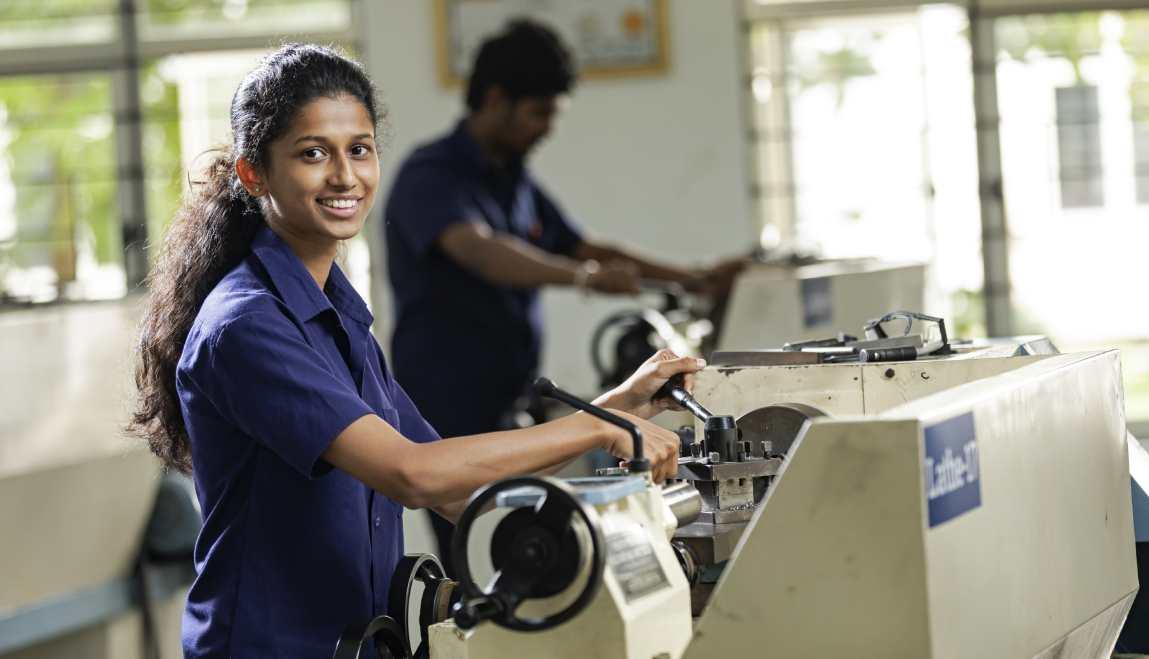
And then there's Meera. Third year, mechanical engineering. A two-hour commute each way she complains about constantly but has never once skipped. She tutors her younger cousins on Sundays and has three internship applications half-finished on her laptop.
Same family, three women, three completely different lives — multiply that by a few million households and you start to get a real sense of what women education in India looks like past the policy documents. It isn't a single scheme or a number on a chart. It's a slow, uneven shift in what a daughter is even allowed to try for.
The importance of women's education in India extends far beyond academic achievement. It shapes the opportunities available to women, strengthens families and creates the foundation for long-term social and economic progress.
Here's a part that doesn't get said enough: Benefits of women's education rarely stops with woman. A mother who's had even a couple of extra years of schooling tends to keep her own children in school longer too, partly because she's better placed to argue with a school office when an admission or attendance record goes sideways.
Health moves the same way — mothers with more schooling are more likely to go for prenatal checkups, more likely to catch a child's illness early. Not a hunch. It turns up again and again in studies from very different corners of the country, from Kerala to Uttar Pradesh, villages and cities alike.
One girl finishing school changes more than her own résumé. It changes what her household looks like years out — healthier kids, better-managed money, decisions made with more information than her own mother had. Educate a woman, and it doesn't stop with her. It travels sideways too, to a younger sister watching from the next room, or a neighbor’s daughter who now has someone to point to.
Set the social argument aside; there's a purely economic one right next to it. India's female literacy figures have genuinely climbed over the last few decades, and recent national data shows girls matching or outnumbering boys in enrollment at several stages of schooling, right through postgraduate study. But finishing school is only half the story.
Female workforce participation hasn't kept pace — plenty of women who are entirely qualified simply aren't in paid work, and the reasons aren't mysterious: who's expected to run the household? whether the commute feels safe after dark, whether there's a job nearby that fits around everything else she's already doing.
Most economists who study this agree. The gap between how educated Indian women are and how many are actually earning is, by most estimates, one of the largest sources of untapped growth sitting in plain sight — and the expensive part, the schooling, is already paid for. What keeps stalling is the next step: turning that education into a job or a small business. Empowering women through education only really pays off once it's followed by a real shot at work, at credit, at owning something outright, not just a certificate on a wall.
None of this should get dressed up as finished business. Challenges in women's education includes dropout rates for girls still spike hard around secondary school age — early marriage, safety concerns, long distances to school, or the sheer volume of unpaid work already expected at home. A family in rural Bihar isn't working with the same obstacles as one in urban Bengaluru, and state literacy numbers still swing wildly depending on where you look.
Scholarships, hostels in remote districts, cash transfers tied to attendance — these have genuinely helped. But access still isn't equal, and treating a rising national average as the end of the conversation would leave out every girl still waiting for her first real shot.
Most days, Meera isn't thinking about any of this. She's thinking about a thesis deadline, an internship rejection email she hasn't opened, whether she'll get home in time for her cousin's exam revision. Her grandmother, though, sees all three generations at once every morning she watches Meera leave for college. A woman who never learned her letters. A daughter who could read but was stopped halfway. A granddaughter training to build machines for a living.
Women education and empowerment in India doesn't show up as one dramatic moment on a calendar. It's built out of hundreds of small, unglamorous decisions — a family deciding a daughter gets to finish what she started, a school going to find a girl who's stopped showing up, a woman opening a bank account under her own name for the first time. None of it looks like much while it's happening. It adds up anyway, quietly, into healthier households, sturdier communities.
But here's what demands introspection: What does a girl's education truly amount to if she finishes school only to be confined to unpaid domestic work? What progress have we really made if we celebrate her degree while denying her the opportunity to earn, to contribute financially to her household, to build independence? Education without the freedom to work isn't empowerment—it's a promise interrupted.
Real societal progress requires more than classrooms. It demands that we create pathways for women to enter the workforce, that we actively educate all members of the family to equally share household responsibilities and that we fundamentally shift how families think about a woman's place within the house and in the economy. The education is already there. The talent is already trained. What we're still waiting for—what we must build—is the ecosystem that actually allows women to use it.
Divya Modi's work in education and social impact reflects this belief, supporting initiatives that help children and young women access learning opportunities and build better futures.
Are we truly empowering women, or are we simply educating them and then asking them to disappear back in their homes?
.webp)

Post a comment